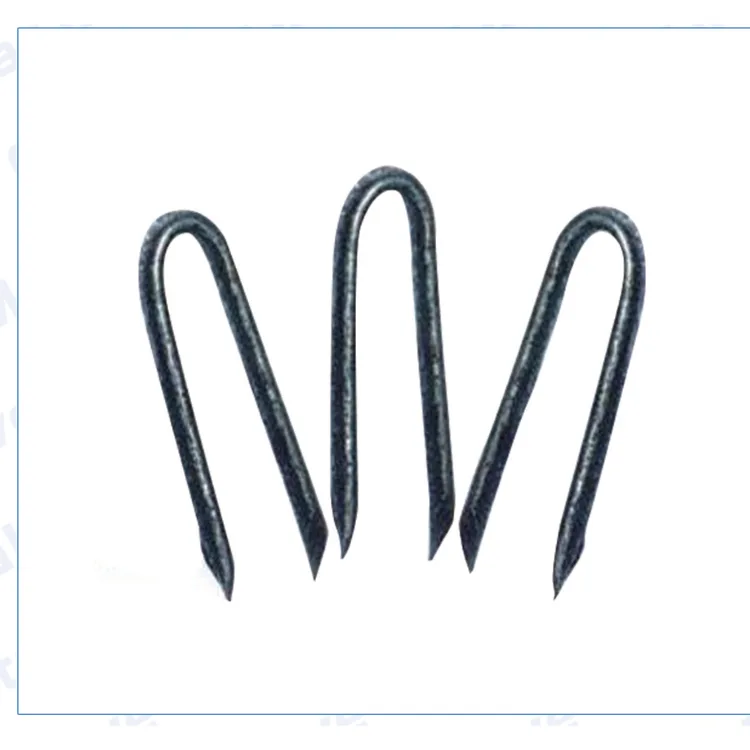
We are Hebei Leeter Import and Export Co., Ltd ("Leeter"), a construction wire, mesh and fencing manufacturer in Dingzhou, Hebei, China, exporting since 2006 to buyers across North America, Europe, Australia and New Zealand. Fence staples ship alongside our fence wire in most rural-supply containers, and this guide covers the specs the farm and ranch trade actually orders.
What fence staples do
A fence staple is a U-shaped, double-pointed nail that pins wire to a wooden fence post. It is the standard fastener for attaching field fence, welded wire and barbed wire to timber posts: the 1/4 inch crown bridges the wire, the two legs drive into the post, and the wire stays free to flex and be re-tensioned underneath. Note the wooden-post qualifier — steel posts fasten differently. A T post holds wire with clips over its studded face, and a Y post (star picket) uses wire clips through punched holes, so staples only enter the picture where a fence line runs timber posts, corner assemblies or wooden strainers.
Standard sizes and staples per pound
All six lengths share the same 9 gauge wire and 1/4 inch crown; only the leg length changes.
| Length | Metric | Count per pound | Typical application |
|---|---|---|---|
| 1" | 25.4mm | ~106 | Welded wire and light mesh on dense hardwood posts |
| 1-1/8" | 28.6mm | — | Light mesh where 1" feels marginal |
| 1-1/4" | 31.8mm | — | General mesh fencing on hardwood |
| 1-1/2" | 38.1mm | — | The all-round farm size: field fence on most posts |
| 1-3/4" | 44.5mm | — | Barbed wire and field fence on softwood posts |
| 2" | 50.8mm | ~53 | Barbed wire, high-tensile wire, soft-treated pine posts |
Count per pound runs from about 106 at 1 inch down to about 53 at 2 inches — a 2 inch staple simply carries twice the steel. That matters for budgeting: a 50 lb box of 1-3/4 inch staples fences far fewer attachment points than the same box of 1-1/4 inch, so estimate staples by count (posts x wires per post), then convert to weight for the order.
The length rule of thumb: the harder the post, the shorter the staple. Dense hardwood grips a 1 to 1-1/4 inch staple firmly, while soft treated pine needs 1-3/4 to 2 inches of leg to reach the same hold. High-tension jobs — barbed wire, high-tensile strainer runs — take the long end of the range regardless of timber.
Barbed vs smooth shank
| Feature | Smooth shank | Barbed shank |
|---|---|---|
| Legs | Plain round wire | Serrated barbs cut into each leg |
| Driving | Fast and easy | Slightly harder to drive |
| Pull-out resistance | Standard | Much higher — barbs lock into the wood |
| Removal / re-tensioning | Easy to pull and restaple | Difficult to extract |
| Best for | Hardwood posts, lines that get re-worked | Softwood posts, stock pressure, high-tensile fence |
Smooth shank is the traditional default: it drives fast, and pulling a staple to re-tension a wire is a routine fencing task. Barbed shank exists because soft treated posts and heavy stock pressure work smooth staples loose over the years — the barbs grip the wood fibers and roughly stay put for the life of the post. Most of our AU/NZ and North American buyers now split their orders: smooth for the general trade, barbed for the treated-pine and cattle-country market.
Finishes: bright, cement coated or hot-dip galvanized
- Bright (plain) — bare polished steel. Cheapest, fine for temporary work and dry interiors, but it rusts quickly in a fence line.
- Cement coated — a resin coating that heats up as the staple drives and then grips like an adhesive, boosting holding power. Corrosion protection is modest; the coating is about grip, not weather.
- Hot-dip galvanized (HDG) — a thick zinc coating that matches the service life of galvanized fence wire. This is the specification for permanent fencing: an unprotected staple becomes the first rust point on an otherwise galvanized fence, and a failed staple drops the wire.
The matching principle is simple — fasteners should not fail before the wire they hold. If you sell Class 3 galvanized field fence or barbed wire, sell HDG staples next to it.
Stapling technique: why the wire must stay loose
Retail buyers ask distributors technique questions, so it pays to know the answer. A fence staple should pin the wire to the post, not clamp it. Drive the staple at a slight angle so the two legs straddle the wood grain instead of entering the same fiber line — legs in the same grain line act like a wedge and can split the post. Tilt the crown a few degrees off vertical so each leg bites fresh wood, and stop driving while the wire can still slide freely under the crown. An over-driven staple kinks the wire, creates a stress point that becomes the first break in a tensioned run, and makes re-tensioning impossible without pulling the staple. On line posts the wire should float; only at strainer and corner assemblies is the wire tied off rather than merely stapled. This is also why smooth-shank staples remain popular with professional fencers despite lower holding power — routine maintenance means pulling and re-driving staples for the life of the fence.
Ordering fence staples for import
Staples are quoted by weight, packed in cartons or small buckets on pallets, and they ship dense, so they are a filler product that tops off fence-wire containers at almost no extra freight. A complete inquiry line reads: length, shank (smooth or barbed), finish (bright, cement coated or HDG), and pack format with total weight. For assortment planning, 1-1/2 and 1-3/4 inch HDG are the fastest movers in rural retail, with 2 inch barbed close behind in treated-post markets, and the short 1 to 1-1/4 inch sizes selling into hardware and light-mesh channels. As the manufacturer we form all six lengths from the same 9 gauge galvanized-grade wire, hold the 1/4 inch crown consistent so retail claims match the box, and can print private-label cartons for retail programs.
Frequently asked questions
What size fence staples should I use for barbed wire?
Use the long end of the range — 1-3/4 or 2 inch — especially on soft treated-pine posts, and consider barbed shank for permanent hold. On dense hardwood posts, 1-1/2 inch is usually sufficient. Drive staples at a slight angle to the grain and leave room for the wire to slide during tensioning.
What gauge are fence staples?
Standard fence staples are 9 gauge wire with a 1/4 inch crown across all six lengths from 1 to 2 inches. The gauge stays constant; only the leg length changes with the size, which is why longer staples weigh more and count fewer per pound.
How many fence staples are in a pound?
About 106 staples per pound at 1 inch, decreasing with length to about 53 per pound at 2 inches. Estimate your job by count — posts multiplied by the number of wires stapled at each post — then convert to pounds to place the order, since staples are sold by weight.
Should I buy barbed or smooth shank staples?
Smooth shank drives faster and pulls easily when you need to re-tension or repair a wire, which suits hardwood posts and lines that get re-worked. Barbed shank locks into the wood and resists pull-out, which suits soft treated posts, heavy stock pressure and high-tensile fencing. Many distributors stock both and let the post timber decide.
Do fence staples work on steel T posts or star pickets?
No. Staples are for wooden posts only. Steel T posts hold wire with clips over the studded face, and star pickets (Y posts) use wire clips through their punched holes. On a fence line that mixes timber and steel posts, order staples for the wood and the matching clips for the steel.
