
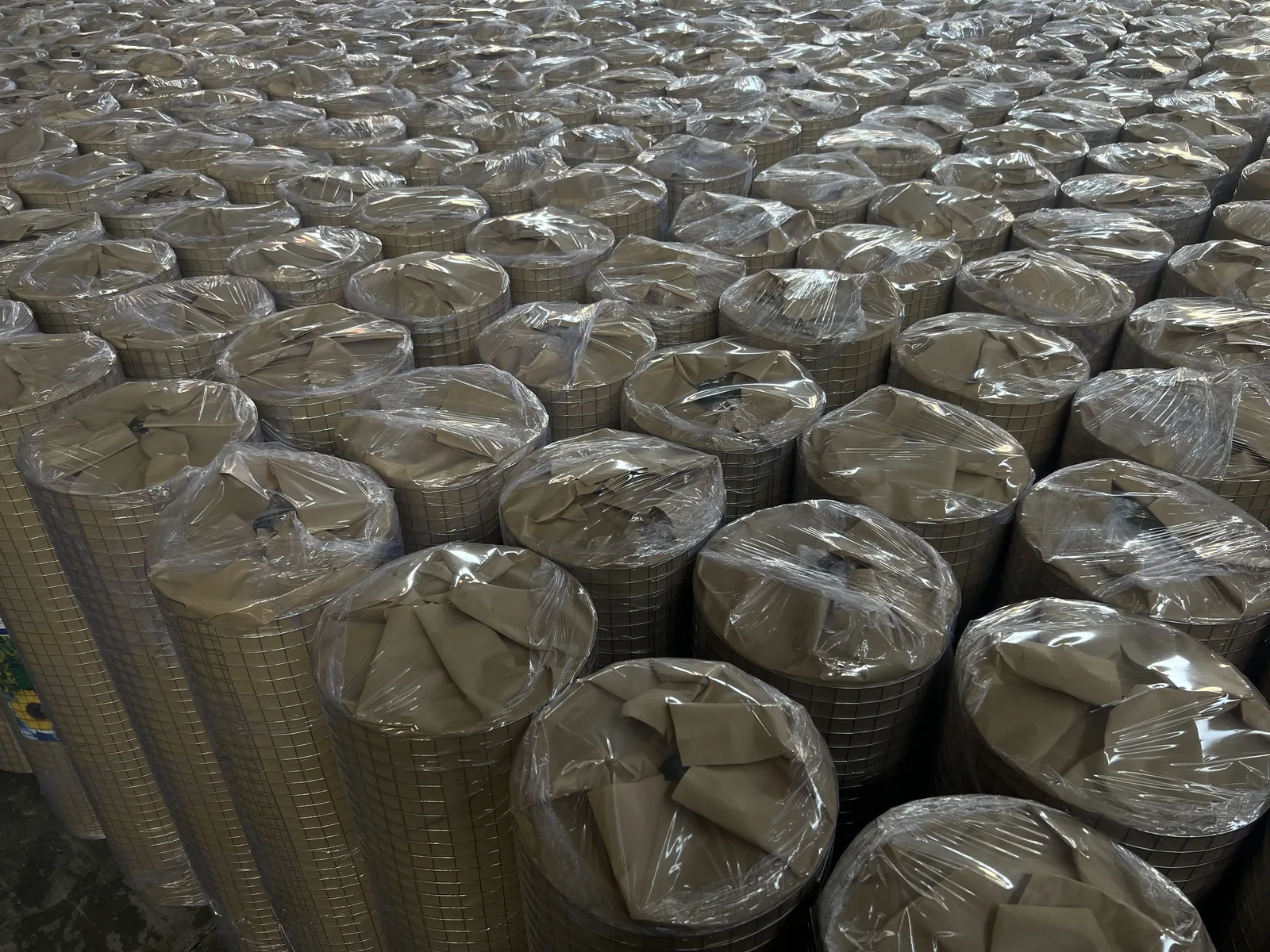
At Hebei Leeter's Dingzhou manufacturing plant, every container load of galvanized wire, welded wire mesh, hexagonal wire netting and chain-link fence fabric follows a strict anti-condensation packing protocol before sealing at Tianjin (Xingang) port.
Why does white rust form inside sealed ocean containers?
Galvanized zinc coatings owe their 15–30 year outdoor service life to a thin, insoluble zinc carbonate patina ($\text{ZnCO}_3$) that forms naturally when zinc reacts with carbon dioxide ($\text{CO}_2$) in freely moving air through wet-and-dry weather cycles.
Inside a tightly wound wire coil or a shrink-wrapped roll of welded mesh stacked in a closed 20GP shipping container, that protective cycle fails:
- Container Rain (Dew-Point Condensation): During a 25-to-45-day ocean voyage from North China to North America, Europe or Australia, container roof temperatures swing from 55 °C (131 °F) by day to 15 °C (59 °F) at night. Moisture evaporated from green wooden pallets or humid port air condenses on the cold steel wire.
- Oxygen & $\text{CO}_2$ Starvation Between Windings: Capillary action sucks condensation water into the tight crevices between adjacent wire turns. Because air and $\text{CO}_2$ cannot circulate inside the coil, the zinc cannot form a stable carbonate film.
- Rapid Zinc Hydroxide ($\text{Zn(OH)}_2$) Consumption: The trapped water reacts aggressively with pure zinc, consuming 5 to 15 microns (35–105 g/m²) of zinc coating in a matter of days and leaving a bulky white or dark-gray powder.
How to inspect and classify white rust severity on arrival
Not all white storage stain requires rejecting a shipment. The American Galvanizers Association (AGA) and EN ISO 1461 classify wet storage stain into three actionable grades:
| Severity Grade | Visual Appearance | Zinc Coating Loss (µm / g/m²) | Structural & Corrosion Impact | Standard Remediation & Disposition |
|---|---|---|---|---|
| Grade 1: Light Superficial Film | Faint white or light-gray chalky dust on outer wraps; no rough texture | < 1–2 µm (< 10–15 g/m²) | Zero impact on service life; patina forms normally once exposed to open air | Accept as-is. Brush off with stiff nylon bristle brush if aesthetic appearance is required for retail display |
| Grade 2: Moderate White Deposit | Heavy white powder between windings; slight dulling of underlying zinc | 3–8 µm (20–55 g/m²) | Acceptable on heavy HDG (Class 1/Class 3 ≥90–240 g/m²); borderline on thin EG (15–25 g/m²) | Conditional accept after magnetic thickness gauge check. Wash with 5% mild acetic acid / vinegar, rinse and dry thoroughly |
| Grade 3: Heavy Dark / Black + Red Rust | Thick crust turning dark gray/black with red iron-oxide spots bleeding through | > 15–35+ µm (Zinc layer penetrated to steel base) | Sacrificial zinc barrier depleted; premature field rust guaranteed | Reject affected coils/rolls under AQL Major Defect clause |
The Leeter 4-layer VCI & sea-freight packaging protocol
To guarantee that galvanized coils, small retail coils and welded mesh rolls arrive bright and retail-clean after crossing the equator or North Pacific, specify these four factory controls on your purchase order:
Layer 1: Water-Quench Cooling & Passivation on the Galvanizing Line
Wire must never be wrapped while still warm from the 450 °C (842 °F) zinc bath. On our Dingzhou hot-dip line, wire passes through a multi-stage water-wash and cooling trough plus a trivalent chromate or silane passivation bath before reaching the coiling blocks at ambient temperature (<32 °C / 90 °F). Coiling hot wire traps steam inside the bundle.
Layer 2: VCI + Kraft Inner Vapor Barrier + Woven Outer Armor
Never wrap bare galvanized steel directly in cheap non-breathable plastic film if residual moisture is present. Our export wrapping sequence uses:
- For Galvanized & Black Annealed Coils (25–500 kg): Inner VCI-treated moisture-barrier PE film + outer high-tensile woven PP or hessian cloth wound on automated rotary wrapping machines.
- For Welded Wire Mesh & Hex Netting Rolls: Heavy waterproof kraft paper inner wrap (absorbs micro-condensation and buffers sharp wire ends) + outer shrink film.
- For Retail Small Coils & Double-Loop Ties: Sealed polybags with VCI anti-corrosion emitter sheets inside double-wall master cartons.
Layer 3: ISPM-15 Kiln-Dried Pallets (<18% Timber Moisture)
Freshly sawn green lumber pallets can release 3 to 6 liters (0.8 to 1.6 gallons) of water vapor into a closed 20GP container when heated in tropical sun. Always specify ISPM-15 heat-treated fumigated pallets kiln-dried below 18% moisture content (or steel skids / floor-loaded herringbone coils for bulk wire).
Layer 4: Calcium Chloride Container Desiccant Strips
For trans-oceanic routes exceeding 20 days, hang 6 to 8 × 1.0 kg Calcium Chloride ($\text{CaCl}_2$) + starch gel desiccant poles along the container lashing rings. Calcium chloride absorbs up to 200%–300% of its own weight in moisture (4× more than silica gel) and locks it as a non-leaking gel.
Packaging comparison by product line for 20GP / 40HQ sea freight
| Product Line | Standard Unit Pack | Inner Anti-Rust Barrier | Outer Transit Protection | Container Stowage & Payload (20GP) |
|---|---|---|---|---|
| Galvanized Wire Coils (25–50 kg) | Strapped coil (ID 450 mm) | PE film + VCI treatment | Woven PP cloth or hessian | Floor-loaded herringbone or 20 pallets (26,000–28,000 kg) |
| Small Coil Tie Wire (3.5 lb / 50 g–1 kg) | 20 coils/carton (70 lb / 31.8 kg) | VCI paper liner + PE shrink | 5-ply corrugated master carton | 48 cartons/pallet × 20 pallets = 960 cartons (~28,000 kg) |
| Welded Wire Mesh Rolls | 0.9–1.8 m × 15–30 m roll | Waterproof kraft paper | Shrink film + pallet stretch wrap | Vertical or pyramid stack (18,000–24,000 kg) |
| Chain-Link Fence Fabric | Compacted 15–25 m roll | Passivated dry weave | Woven PP bags capped on both roll ends | Floor-loaded interlocking rows (22,000–26,000 kg) |
Frequently asked questions
Does white rust mean the galvanized wire was defective?
Not necessarily. Even heavily hot-dip galvanized wire meeting ASTM A641 Class 3 (≥240 g/m²) will develop white rust within 48 hours if rain or container condensation gets trapped between tight windings without airflow. White rust is an environmental storage/transit reaction, prevented by dry coiling, passivation, VCI wrapping and kiln-dried pallets.
Why is kraft paper better than plastic film alone for welded wire mesh rolls?
Plastic shrink film alone acts as a greenhouse: if any ambient moisture is sealed inside the roll during packing, solar heating vaporizes it and re-condenses water droplets directly against the zinc surface. Wrapping the roll first in heavy waterproof kraft paper cushions the cut wire ends from puncturing the outer film and wicks condensation away from the metal-to-metal contact points.
How should galvanized wire and mesh be stored after unloading at the warehouse?
Store pallets indoors in a dry, ventilated warehouse off the concrete floor, and slit open outer plastic stretch-wrap if condensation is visible inside the film so air can circulate. Never leave plastic-wrapped galvanized coils sitting outdoors in direct sunlight and rain.
Manufactured by Hebei Leeter Import and Export Co., Ltd., operating dedicated cold-drawing, hot-dip galvanizing and automated export packaging lines in Dingzhou, Hebei, China under ISO 9001:2015.
