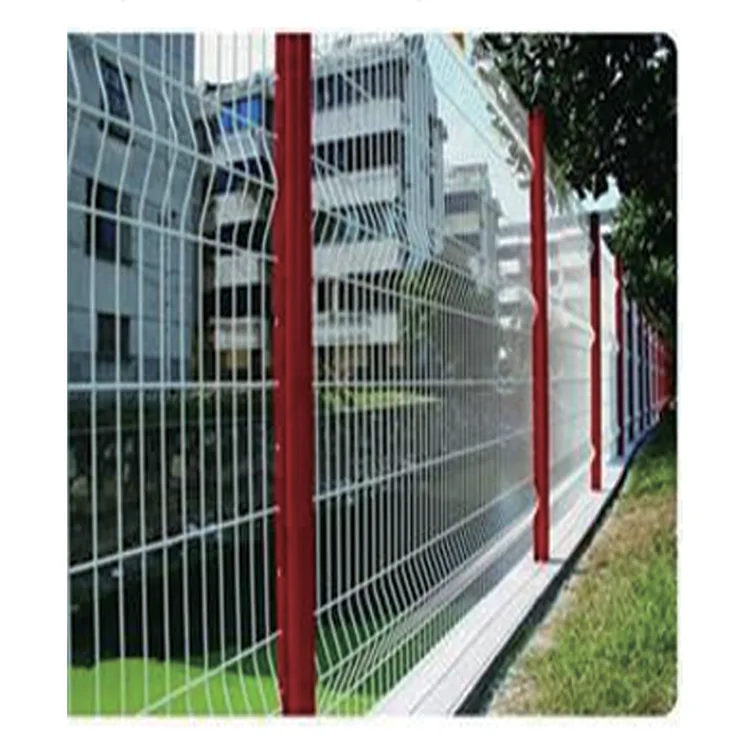
I run the export desk at Hebei Leeter Import and Export Co., Ltd ("Leeter"), a Dingzhou, Hebei manufacturer that welds and galvanizes the full perimeter range — 358, palisade, welded panel and temporary — so a buyer can standardize one specification across a site from one factory.
The four security fence types, and what each resists
| Type | What it is | Resists | Typical use | Standard |
|---|---|---|---|---|
| 358 anti-climb mesh | Welded mesh, aperture 76.2 × 12.7 mm (3 × ½ in), 8/8/6 ga wires | Finger- and toe-holds (no foothold), bolt-cutters, cutting delay; double-skin for higher ratings | Prisons, data centers, substations, airports | BS 1722-14; ratings via LPS 1175 |
| Steel palisade | Vertical pales (W or D section) on rails | Climbing (spiked top), visual deterrent; less cut-resistant than 358 | Utilities, commercial yards, industrial sites | BS 1722-12 (GP ≤2.4 m, SP 3.0 / 3.6 m) |
| Welded 2D/3D panel | Rigid welded panel, twin-wire (2D) or V-beam (3D) | General perimeter deterrence; rigid, tidy, low maintenance | Commercial, logistics, schools, general perimeter | BS 1722-14 |
| Temporary panel | Free-standing mesh panel in a ballast foot | Casual entry, site control; not a hard barrier | Construction sites, events, crowd control | AS 4687 (and regional) |
Deep-dive specs for each: 358 anti-climb vs palisade · 3D welded panels · temporary fence panels.
Security ratings and standards — specify the rating, not the adjective
"High security" means nothing on a purchase order. What a specifier names is a certified attack-resistance rating:
- LPS 1175 (Loss Prevention Standard, UK/LPCB) grades a fence by how long it delays an intruder using a defined toolkit. Ratings run roughly SR1 → SR5 (older A1/B3 nomenclature maps into this), each tied to a tool category and a minimum delay. A single-skin 358 panel typically certifies around SR1 (A1); a double-skin 358 system reaches SR2 and beyond. Certificates are issued per issue number — check the LPCB Red Book, not the brochure.
- BS 1722 is the British fencing family: Part 12 steel palisade, Part 14 welded mesh panel (the 358 and 2D/3D systems), Part 10 anti-intruder chain-link. BS 1722-12 sizes components for a 900 N/m² design wind load.
- Anti-climb ≠ anti-cut. A 76.2 × 12.7 mm aperture denies a foothold (anti-climb); cut resistance comes from wire gauge and double-skinning. A spec needs both addressed.
For exports to North America, pair these with the ASTM/AASHTO equivalents your market names — see choosing a Hebei fence manufacturer for North American importers.
Match the fence to the application
| Site | Primary threat | Recommended type | Topping / height |
|---|---|---|---|
| Data center / telecom | Tooled intrusion, standoff | Double-skin 358 (LPS 1175 SR2+) | 3.0 m + razor or spike; see data center guide |
| Electrical substation / utility | Climbing, theft | 358 or palisade SP | 2.4–3.0 m + anti-climb top |
| Airport perimeter | Intrusion + wildlife | 358 or welded panel + buried skirt | 3.0 m + razor coil |
| Prison / correctional | Escape + tooled attack | Double-skin 358, highest SR | 5–6 m + razor, detection |
| Commercial / industrial yard | Deterrence, theft | Palisade or 358 | 2.4 m + spike/triple-point |
| Logistics / warehouse | Deterrence at scale | Welded 2D/3D panel | 2.0–2.4 m |
| Construction site / event | Casual entry, site control | Temporary panel + ballast | 2.0 m; see temporary panels |
Toppings, height and the add-ons that change the rating
Height buys climb-over time; toppings buy the rest. Razor concertina (BTO/CBT) is the strongest deterrent; rotating anti-climb spikes and triple-pointed extension arms add to palisade and panel tops. A clean rule: specify the base fence's rating first, then add topping and height — adding razor to an un-rated panel does not create a rated system. Buried mesh skirts stop dig-under at airports and substations.
Specifying and importing it
Put these on every security-fence PO so quotes compare and the goods clear customs:
- Coating: hot-dip galvanized then polyester powder-coated (HDG + PPC) for outdoor life — galvanize after welding so joints are sealed (see galvanized before vs after weld).
- Wire / section: actual wire gauge with tolerance (358 is commonly 8/8/6 ga = 4.0/4.0/5.0 mm); palisade pale section (W or D) and thickness.
- Standard: BS 1722 part number and any LPS 1175 SR target; ASTM/AASHTO where your market requires.
- Posts, clips, fixings and anti-tamper hardware — specified, not assumed.
- Container plan: panels and posts pack and ship together; mesh and fence consolidate with other lines (importing fencing hardware).
Leeter's perimeter-security snapshot
| Company | Hebei Leeter Import and Export Co., Ltd (Leeter) |
| Factory | Dingzhou, Hebei — own welding and galvanizing; export HQ Shijiazhuang |
| Range | Permanent fencing: 358 anti-climb, steel palisade, welded 2D/3D panel; temporary fencing |
| Standards | BS 1722-12 / -14 to spec; ASTM / AASHTO references on request; HDG + PPC coatings |
| QC & terms | ISO 9001; EN 10204 3.1 MTR; third-party inspection welcome; FOB/CIF Tianjin (Xingang); mixed containers accepted |
Frequently asked questions
What is the best fence for high security?
For a hard delay against a tooled intruder, a double-skin 358 anti-climb welded mesh fence rated to LPS 1175 SR2 or higher, 3.0 m tall with a razor or spike topping and a buried skirt where dig-under is a risk. 358's 76.2 × 12.7 mm aperture gives no foothold and resists bolt-cutters; the rating, not the word "secure", is what makes it specifiable. Steel palisade is a strong visual deterrent but is less cut-resistant than double-skin 358.
What is a 358 fence?
A 358 fence is welded mesh named for its imperial aperture — 3 × ½ inch with 8-gauge wire (76.2 × 12.7 mm) — a mesh so tight it offers no finger or toe hold and resists bolt-cutters. It is specified under BS 1722-14 and certified for attack resistance under LPS 1175 (SR1 single-skin, SR2+ double-skin). It is the default choice for prisons, data centers and substations.
What does LPS 1175 SR mean?
LPS 1175 is a UK security standard (LPCB) that rates a product by how long it delays an intruder using a defined set of tools. Security Ratings run from SR1 (opportunist, hand tools) upward through SR2–SR5 (progressively heavier tools and longer delay). A fence should carry a current certificate for the rating claimed — verify it in the LPCB Red Book, because ratings are tied to issue numbers.
Palisade or welded mesh for a commercial site?
Steel palisade (BS 1722-12) is a cost-effective, aggressive visual deterrent and is easy to repair pale-by-pale, which suits commercial and utility yards. Welded 2D/3D panel (BS 1722-14) is rigid, tidy and lower-maintenance for general perimeters; 358 mesh is the step up when cut and climb resistance must be certified. For a yard needing deterrence rather than a rated barrier, palisade or a heavy welded panel usually wins on cost.
What fence should I use for a construction site?
Free-standing temporary fence panels in ballast feet — fast to install and relocate, specified to AS 4687 (or your regional standard), typically 2.0 m. They control access and meet site-safety duties but are not a hard security barrier; where theft of plant is the risk, upgrade the compound to anti-climb mesh. See the temporary fencing panel guide.
