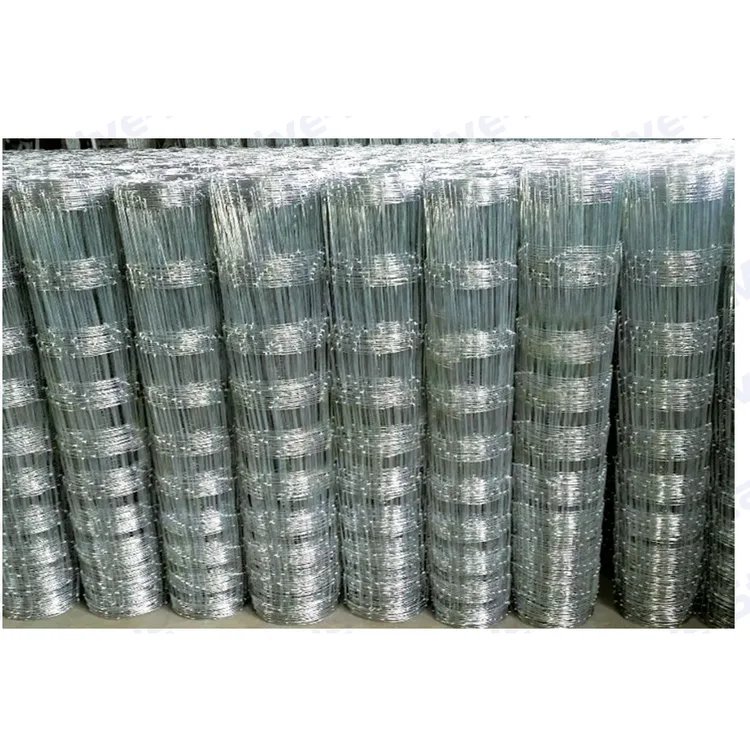
We are Hebei Leeter Import and Export Co., Ltd ("Leeter"), a wire, mesh and fencing manufacturer in Dingzhou, Hebei, China, exporting since 2006 to farm-store and ranch-supply buyers across North America and Europe. We weave field fence to either coating class on the same looms, so the trade-off below is the single most common conversation we have on an agricultural fence RFQ.
What ASTM A116 actually specifies
ASTM A116 is the standard for metallic-coated steel woven wire fence fabric — the hinge-joint and fixed-knot rolls sold as field fence. It sets a minimum zinc coating weight by class, measured in ounces per square foot of wire surface (test method ASTM A90). The two classes buyers ask for are Class 1 and Class 3.
| Coating class | Zinc weight (min) | Metric | Approx. zinc thickness | Typical service life* |
|---|---|---|---|---|
| Class 1 | ~0.28 oz/ft² | ~85 g/m² | ~12 µm (0.5 mil) | 5–10 years |
| Class 3 | ~0.80 oz/ft² | ~244 g/m² | ~34 µm (1.4 mil) | 13–30 years |
*Service life is the years before significant red rust in normal, non-coastal exposure; it shortens in coastal, high-humidity or heavily fertilized ground.
Two honest caveats. First, A116 sets the minimum as a function of wire diameter, so a heavy 2.5–3.5 mm line wire carries proportionally more zinc than a fine inner wire at the same class — the 0.28 and 0.80 figures are the widely quoted reference values, not a single number for every wire in the roll. Second, "galvanized" alone tells you nothing: a roll can be truthfully labelled galvanized and still be Class 1. Always specify the class on the purchase order.
Why zinc weight maps to fence life
Zinc protects steel two ways: it is a physical barrier, and it is sacrificial — it corrodes in place of the steel around a scratch or cut end. Both mechanisms are consumed over time at a rate set mostly by how wet, salty and polluted the air is. Because the zinc corrodes at roughly a steady microns-per-year rate for a given environment, a coating that starts about 2.5 times thicker lasts roughly 2.5 times longer before the steel is exposed. That is the whole logic of Class 3: same steel, same knot, more years.
This is also why coating class matters more than a heavier steel gauge for longevity. A thicker wire rusts more slowly to failure once the zinc is gone, but it does not delay the day the zinc runs out — only more zinc does that. For a perimeter fence expected to stand 20-plus years, Class 3 is the cheaper decision per year of service even though the roll costs more up front.
How to choose a class by climate and design life
- Dry inland pasture, tight budget, or short design life: Class 1 is defensible. On dry rangeland a Class 1 fence can reach the high end of its 5–10 year band, and for a rented paddock or a fence you plan to replace with the next land-use change, the lower cost wins.
- Humid, high-rainfall or long-life ranch perimeter: Class 3. This is the default for buyers who quote fencing as a 20-year capital item and do not want to re-string a boundary line twice in a working lifetime.
- Coastal or heavily corrosive ground (salt air, feedlot ammonia, fertilizer): move beyond plain zinc — see below. Even Class 3 pure zinc is consumed fast within a few kilometers of surf.
Design life is the number that settles most arguments: decide how many years the fence must stand, then buy the class that clears it in your climate with margin. Under-coating a long-life fence to save on the roll is the most expensive mistake in agricultural fencing, because the labor to pull and re-hang a failed boundary dwarfs the coating upcharge.
Beyond Class 3: zinc-aluminum coatings
Where pure zinc is not enough, a zinc-5% aluminum alloy coating (the Zn-Al mischmetal class under ASTM A856, sold in the trade as Bezinal or Galfan) corrodes far more slowly than plain zinc of the same weight — commonly two to three times the life. For coastal ranches and marine air we recommend a Zn-Al high-tensile fence rather than simply piling on more pure zinc, because at equal coating weight the alloy buys more years than Class 3 can. It costs more than Class 3 and is worth quoting only when the environment justifies it.
What we specify on the factory floor
On our side, coating class is a line item we set per order, not a fixed grade — the same field-fence loom runs Class 1 for a price-driven market and Class 3 for a long-life ranch spec. Three things we tell buyers before they commit:
- Match the class to the coating on your posts and clips. A Class 3 fabric hung on lightly galvanized clips and painted posts fails at the fittings first. If you also stock galvanized T-posts, coat the whole system to the same design life; our note on galvanized vs painted T-posts covers the pairing.
- Ask how the zinc was applied, not just the class. Hot-dip after drawing gives the durable heavy coat used for Class 3; a thin electro-galv layer will never reach Class 3 weight. Our guide to hot-dip vs electro-galvanized wire explains why the process caps the achievable coating.
- Get the coating class and weight on the mill or test certificate. A Class 3 claim should come with an ASTM A90 coating-weight result in the paperwork, so the delivered roll can be verified rather than trusted.
For the height, wire diameter and knot side of the decision, pair this with our field fence heights and spacing guide and the hinge-joint vs fixed-knot comparison — coating class, geometry and knot are the three independent choices on any field-fence order.
Frequently asked questions
What is the difference between Class 1 and Class 3 galvanized field fence?
Class 3 carries about 0.80 oz/ft² of zinc versus about 0.28 oz/ft² for Class 1 — roughly two-and-a-half times as much on the same steel. Both are defined under ASTM A116. The extra zinc is why Class 3 lasts about 13–30 years in non-coastal climates while Class 1 lasts about 5–10 years.
How long does galvanized field fence last?
In normal, non-coastal exposure a Class 1 field fence lasts about 5–10 years and a Class 3 fence about 13–30 years before significant red rust. Coastal salt air, feedlot ammonia and heavy fertilizer shorten both; dry inland rangeland extends them.
Is Class 3 galvanized worth the extra cost?
For any fence you expect to stand more than about ten years, yes — Class 3 is usually the lower cost per year of service, because the coating upcharge is small next to the labor of pulling and re-hanging a boundary fence that failed early.
What coating should I use near the coast?
Move past plain zinc to a zinc-5% aluminum (Zn-Al / Bezinal) coating under ASTM A856, which lasts roughly two to three times as long as pure zinc of the same weight. Within a few kilometers of salt air, even Class 3 pure zinc is consumed quickly.
How do I verify the coating class I ordered?
Require the coating-weight result from ASTM A90 testing on the mill or third-party certificate, stated in oz/ft² or g/m². A genuine Class 3 roll should show about 0.80 oz/ft²; a "galvanized" roll with no class and no test number should be treated as Class 1 until proven otherwise.
