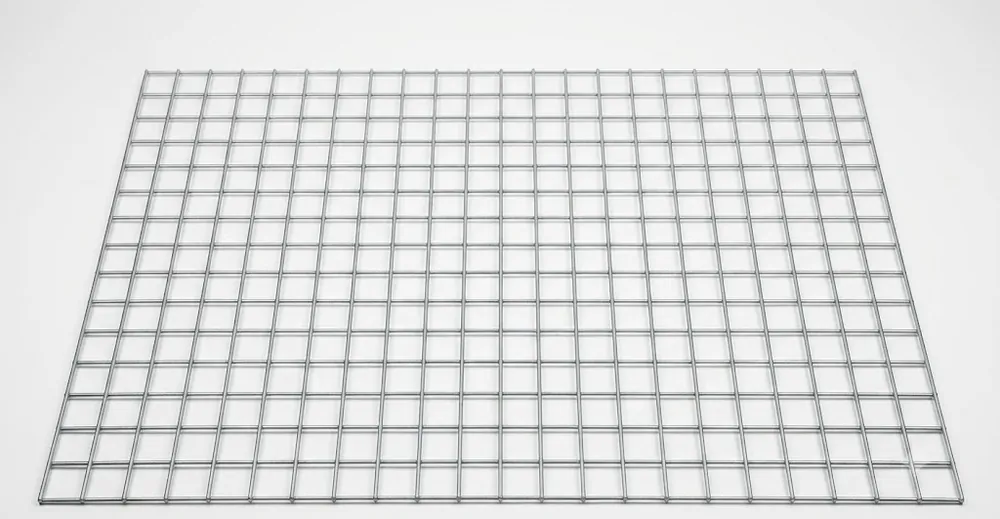
We are Hebei Leeter Import and Export Co., Ltd ("Leeter"), a construction wire and welded mesh manufacturer in Dingzhou, Hebei, exporting since 2006. Because hardware cloth mesh, gauge, width and coating are all made to order, this guide is the same sizing and specification advice we give importers — and it keeps hardware cloth (square mesh) strictly separate from hexagonal chicken wire, which buyers constantly confuse.
Hardware cloth mesh size and gauge chart
The table below is the core reference. Aperture is the nominal opening; the actual clear opening is slightly smaller because it equals the pitch minus one wire diameter (a point most pages get wrong — a 1/4" mesh in 23 ga clears about 0.225", not a full 0.250").
| Mesh (opening) | Mesh count | Aperture (in / mm) | Typical gauge | Wire Ø (in → mm) |
|---|---|---|---|---|
| 1/8" | 8 mesh | 0.125" / 3.18 mm | 27 ga (some 23 ga) | 0.0173" → 0.44 mm |
| 1/4" | 4 mesh | 0.250" / 6.35 mm | 23 ga (up to 19 ga heavy) | 0.0258" → 0.66 mm |
| 1/2" | 2 mesh | 0.500" / 12.70 mm | 19 ga (16 ga heavy) | 0.041" → 1.04 mm |
| 1/2" × 1" | — | 12.7 × 25.4 mm | 16–19 ga | 1.04–1.59 mm |
| 1" × 1" | 1 mesh | 1.000" / 25.40 mm | 16 ga (up to 14 ga) | 0.0625" → 1.59 mm |
The gauge is not fixed — "1/4 inch hardware cloth" is legitimately sold anywhere from light 23 ga (garden) to heavy 19 ga (gopher and predator exclusion). Always confirm the gauge, not just the opening, on your PO. Full gauge-to-millimetre reference for the wires used in hardware cloth:
| Gauge | inch | mm |
|---|---|---|
| 14 | 0.080" | 2.03 |
| 16 | 0.0625" | 1.59 |
| 19 | 0.041" | 1.04 |
| 20 | 0.035" | 0.89 |
| 23 | 0.0258" | 0.66 |
| 27 | 0.0173" | 0.44 |
Which gauge system? (US Steel Wire Gauge, not AWG)
Hardware cloth is quoted in the US Steel Wire Gauge (Washburn & Moen) — the same system used across US wire mesh. Do not read these as AWG: AWG 19 is 0.912 mm, but Steel Wire Gauge 19 is 1.04 mm, and using the wrong table throws your wire diameter off.
There is a second trap for importers. UK and Chinese export sheets often quote the Imperial Standard Wire Gauge (SWG), where 19 SWG = 1.00 mm and 16 SWG = 1.60 mm. Those are close to the US figures (1.04 mm and 1.59 mm) but not identical, so if a spec matters to tolerance, state the exact wire diameter in millimetres on the order rather than trusting "19 gauge" to mean the same thing on both sides. See our wire gauge chart for the full SWG/BWG comparison.
Welded vs woven hardware cloth
Both constructions exist, and the mesh size tells you which is likely:
- Woven hardware cloth interlaces the wires over and under. Traditional 1/8" and 1/4" is often woven — slightly more flexible and conformable, and there are no weld points.
- Welded hardware cloth is resistance-welded at every intersection. It is stronger, more rigid, holds a flat square grid, and won't unravel when you cut it. 1/2" and 1" are predominantly welded.
The practical rule: 1/8" and 1/4" come both ways; 1/2" and 1" are almost always welded. Welded gives rigidity and joint strength; woven gives pliability. Our welded vs woven mesh guide covers the trade-off in depth.
Finish: galvanized-after-weld outlasts galvanized-before-weld
For outdoor hardware cloth, the single biggest durability factor is when the zinc goes on — and it is the detail cheap listings hide behind the word "galvanized":
| Finish | How it's made | Outdoor life |
|---|---|---|
| Galvanized before weld (GBW) | wire zinc-coated, then welded | Weld heat burns the zinc off each joint, so weld points rust first — shortest life |
| Galvanized after weld (GAW) | mesh welded, then hot-dipped in zinc | Every joint is sealed under zinc — longest life of the galvanized options |
| Electro-galvanized | thin electroplated zinc | Bright, uniform, low zinc reserve — for dry/indoor use |
| Hot-dip galvanized | thick zinc bath | Thick zinc reserve — long outdoor life |
| PVC / vinyl coated (usually black) | zinc layer plus bonded polymer | Double barrier — best for coastal, wet and low-glare uses |
The order of merit for exposed hardware cloth is hot-dip GAW > electro GAW > GBW, with PVC-over-galvanized best where salt or aesthetics matter. When a supplier only says "galvanized," ask specifically whether it is GAW or GBW — see our galvanized before vs after welding guide for why the weld nodes are the failure point.
Standard roll sizes and weights
Hardware cloth ships in a small set of stock roll dimensions:
- Widths: 24", 36" and 48" are the volume sellers; 30", 60" and 72" are also stocked. Metric export widths are 0.9 m, 1.0 m and 1.2 m.
- Lengths: 5, 10, 25, 50 and 100 ft (the standard full roll); metric export is 30 m (also 15 m).
Roll weight scales with width for a given mesh and gauge. A representative 1/2" × 1/2", 19 ga, galvanized-after-weld roll runs:
| Width | Length | Weight |
|---|---|---|
| 24" | 100' | 42 lb |
| 36" | 100' | 63 lb |
| 48" | 100' | 84 lb |
| 60" | 100' | 105 lb |
| 72" | 100' | 126 lb |
Lighter meshes (1/4" 23 ga, 1/8" 27 ga) weigh substantially less, so for costing a container always request the mill spec sheet for the exact mesh and gauge rather than assuming one weight table covers all grades.
How to choose the mesh size
Match the opening to the smallest thing you need to stop:
| Mesh | Use it for | Key sizing note |
|---|---|---|
| 1/8" | Fine insect screening, soil sifting, vents, reptile vivaria | Blocks bees, wasps and most insects |
| 1/4" | Rodent-proofing (mice, voles, gophers), gutter guard, tree guards, raised-bed bottoms, snakes | The "if in doubt" size — mice cannot pass 1/4" |
| 1/2" | Chicken-coop predator barrier, rabbit and small-animal fencing, drain guards | Stops rats and predators, but not mouse-proof |
| 1" | Poultry runs, aviaries, heavier enclosures, light structural | Use a smaller mesh where rodents or snakes are the concern |
The mouse threshold is the one buyers get wrong: 1/2" stops rats but young mice squeeze through it, so anywhere mice matter you need 1/4" or finer.
Hardware cloth vs chicken wire
They are not interchangeable, and conflating them is the most common mistake online:
- Hardware cloth is square mesh, welded or woven, in heavier gauges (14–27 ga), rigid, and genuinely predator- and rodent-proof.
- Chicken wire is hexagonal, twisted (not welded), thin, and flexible — fine for keeping chickens in, useless for keeping raccoons, rats or snakes out.
For coop security the mesh that does the work is 1/4" or 1/2" hardware cloth, not poultry netting. See our separate chicken wire sizes guide for the hexagonal side.
Buying hardware cloth from China
For a mesh you are importing by the container, specify to remove ambiguity:
- State mesh AND gauge in millimetres — e.g. "1/4" (6.35 mm) opening, 0.66 mm wire (23 ga US)" — so SWG-vs-US-gauge differences can't cost you tolerance.
- Specify GAW, not just "galvanized" for anything used outdoors, plus the zinc coating weight; add PVC coating and colour for coastal or low-glare jobs.
- Confirm construction (welded or woven) and edge finish, and the roll width, length and count per pallet.
- Ask for a mill spec sheet with actual wire diameter and zinc coating, and allow a third-party check of mesh count and wire gauge before shipment.
As the manufacturer we supply hardware cloth in 1/8"–1" square mesh, welded or woven, electro or hot-dip galvanized-after-weld and PVC-coated, in stock and custom roll sizes — confirm mesh, gauge, finish and width on your order.
Frequently asked questions
What are the standard hardware cloth mesh sizes?
The four standard hardware cloth sizes are 1/8", 1/4", 1/2" and 1" square openings. In metric they are about 3.18 mm, 6.35 mm, 12.70 mm and 25.40 mm. Each pairs with a typical wire gauge — 1/8" at 27 ga, 1/4" at 23 ga, 1/2" at 19 ga and 1" at 16 ga in the US Steel Wire Gauge system — though the gauge can be ordered heavier for predator-proofing.
What gauge is 1/4 inch hardware cloth?
The most common gauge for 1/4" hardware cloth is 23 gauge (0.0258", about 0.66 mm), but it is legitimately sold up to 19 gauge (0.041", about 1.04 mm) for heavier gopher and predator exclusion. Because "1/4 inch" describes only the opening, always confirm the wire gauge on the order rather than assuming one value.
Is hardware cloth the same as chicken wire?
No. Hardware cloth is a square mesh — welded or woven — in heavier gauges, rigid and rodent-proof. Chicken wire is a thin, flexible, hexagonal twisted netting meant to contain poultry, not to exclude predators. For coop security you want 1/4" or 1/2" hardware cloth; chicken wire will not stop raccoons, rats or snakes.
What size hardware cloth keeps mice out?
Use 1/4" (6.35 mm) hardware cloth or smaller. Mice can squeeze through a 1/2" opening, so 1/2" mesh stops rats and larger predators but is not mouse-proof. When rodents are the concern, 1/4" is the standard choice; 1/8" adds insect exclusion.
What does "galvanized after weld" mean, and is it better?
Galvanized-after-weld (GAW) means the mesh is welded first and then hot-dipped in zinc, so the weld joints are sealed under the coating. Galvanized-before-weld (GBW) coats the wire first, and the welding heat burns the zinc off each joint, so those points rust first. For any outdoor use, GAW lasts significantly longer and is worth specifying explicitly.
Sources
- McNichols — Wire Diameters & Wire Gauge Equivalents (carbon steel)
- Howard Wire Cloth — Wire Gauge Conversion Chart (Steel Wire Gauge)
- Louis Page — Galvanized-After-Weld welded mesh roll sizes and weights
- TWP Inc. — Hardware Cloth 101 (welded and galvanized wire mesh)
- American Galvanizers Association — welding and galvanizing reference
