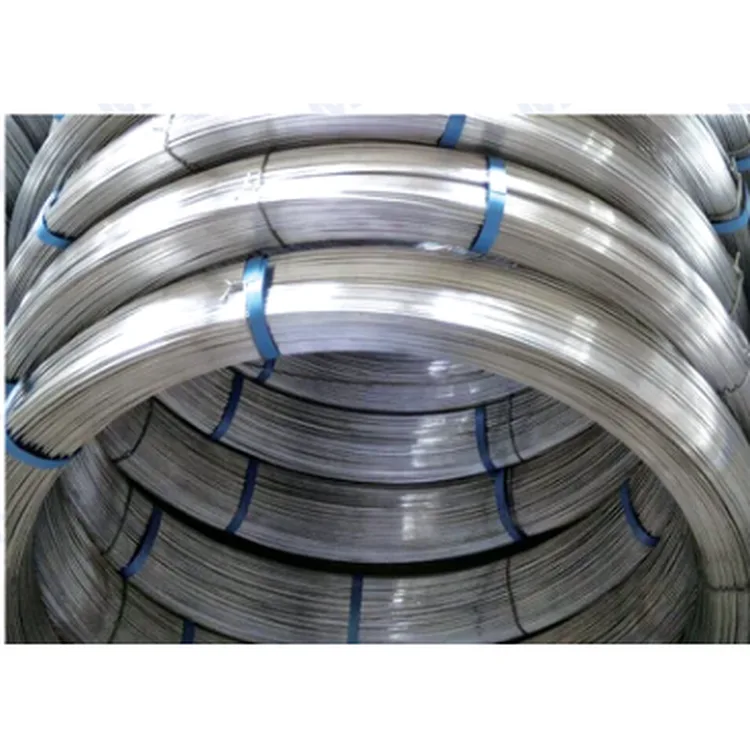
We are Hebei Leeter Import and Export Co., Ltd ("Leeter"), a wire and wire-product manufacturer in Dingzhou, Hebei, China, exporting since 2006 to farm, fencing and industrial buyers across North America and Europe. We draw both product families in-house — soft galvanized wire from SAE 1006/1008 rod and high-carbon wire from 45# through 82B rod — so this guide reflects what we certify and ship, not theory.
Carbon content is the dividing line
Steel wire strength starts with carbon. Low-carbon grades such as SAE 1006/1008 or Chinese Q195/Q235 contain under about 0.10% carbon: the wire draws easily, stays soft and ductile, and tops out around 540 MPa. High-carbon grades are named for their carbon content — Chinese grade 45# is nominally 0.45% carbon, 65# is 0.65%, and rod grades 77B and 82B carry 0.77% and 0.82%. More carbon plus heavier drawing reduction (and patenting heat treatment between draws) is what pushes tensile strength past 2000 MPa.
The cost of that strength is ductility. High-tensile wire resists bending, springs back, and will snap rather than wrap if you treat it like tie wire. That is why the two families do not substitute for each other — they serve different jobs.
| Property | Mild steel wire | High-carbon (high tensile) wire |
|---|---|---|
| Steel grade | SAE 1006/1008, Q195/Q235 | 45#, 55#, 65#, 70#, 77B, 82B |
| Carbon content | ≤ ~0.10% | ~0.45–0.82% |
| Tensile strength | 30–55 kgf/mm² (≈300–540 MPa / 43–78 ksi) | 1300–2200 MPa (≈190–320 ksi) |
| Diameter range (ours) | 0.50–6.00mm (25–4 BWG) | 1.25–5.50mm (18–5 BWG) |
| Ductility | High — ties, twists, wraps by hand | Low — springs back, needs crimps/knots |
| Zinc coating | Electro 10–40 g/m²; hot-dip 50–200+ g/m² | 40–300 g/m² |
| Coil weight | 1–1,000 kg | 50–500 kg |
| Typical price basis | Lower per ton | Higher per ton, lower per unit strength |
Where each wire belongs
Mild steel wire is the workhorse for anything installed by hand-bending: rebar tie wire, binding and baling ties twisted manually, mesh weaving, nails, and general hardware. Its virtue is that it stays where you bend it.
High-carbon wire earns its premium in four export applications we quote constantly:
- Baling wire for recycling and agricultural balers, where the strand is tensioned hard around a compressed bale and must not stretch or break under shock load.
- High-tensile fence line — smooth 12.5 ga (2.5mm) strained-wire fencing and the line wires of woven field fence. Higher strength allows wider post spacing and higher strain, so the fence stays tight through seasons and stock pressure.
- Vineyard and greenhouse wire, carrying trellis and crop loads across long spans year-round with minimal sag.
- Spring stock — mattress, mechanical and agricultural springs drawn from 65# to 82B, where the wire must store and return energy without taking a set.
| Application | Recommended grade | Typical diameter | Why |
|---|---|---|---|
| Rebar tie / binding wire | SAE 1006/1008 (mild) | 0.9–1.6mm (20–16 BWG) | Must twist and hold a knot by hand |
| Manual bale ties | Mild or 45# | 2.0–3.4mm (14–10 BWG) | Balance of strength and twistability |
| Automatic baler wire | 45#–65# | 2.2–3.7mm | Shock-load strength, consistent feed |
| High-tensile fence line | 65#–77B | 2.5mm (12.5 ga) | 1235+ MPa class strand, long spans |
| Vineyard / greenhouse trellis | 65#–70# | 1.8–3.0mm | Low sag, long service under load |
| Springs | 70#, 77B, 82B | 1.25–5.50mm | Maximum strength and elasticity |
Diameters and grades outside these pairings are drawable to order; the table shows the volume standards.
Strength, diameter and real fence economics
The commercial argument for high tensile wire is simple: strength per ton. Breaking load equals tensile strength times cross-sectional area, so a 2.5mm wire at 1400 MPa breaks near 685 kg (about 1,510 lb), while the same 2.5mm in mild steel at 500 MPa breaks near 245 kg (540 lb). To match the high-tensile wire's breaking load in mild steel you would need roughly 4.2mm wire — 2.8 times the steel weight per meter. Freight, handling and post loads all scale with that weight. This is why North American ranch fencing standardized on 12.5 ga high-tensile smooth wire, and why Class 3 galvanized high-tensile field fence dominates the quality end of the market.
For fencing, remember the zinc spec matters as much as the steel spec: our high-carbon wire is galvanized at 40–300 g/m², and permanent fence lines should sit at the heavy end of that range. The reasoning is covered in our electro vs hot-dip coating guide. Where extra corrosion protection or visibility is wanted — top wires, garden and pet applications — a polymer jacket over galvanized core is available as PVC-coated wire.
Handling and installation differences
Crews used to mild wire need three adjustments when they switch to high tensile:
- Joining. High-tensile wire does not hold a hand-twisted splice well. Use crimp sleeves, wire links or a figure-8/double-loop knot rated for the wire class.
- Tensioning. Strain with inline strainers or a tension tool to the maker's recommended working load — typically a fraction of breaking strength — rather than pulling "tight by feel". The wire's low stretch means it reaches working tension quickly.
- Safety. A tensioned high-tensile strand stores real energy. Cut it under control, wear eye protection, and never kink the wire; a kink can cut breaking strength dramatically in any steel wire, but the failure in high-tensile wire is sudden.
Mild wire forgives all of the above, which is exactly why tie and binding applications stay low-carbon.
Specifying and buying from the factory
A complete RFQ for either family names: steel grade, wire diameter (mm or gauge), tensile range in MPa or kgf/mm², zinc coating weight in g/m², coil weight, and packing. We ship mild galvanized wire in 1–1,000 kg coils and high-carbon wire in 50–500 kg coils, both with plastic-film inner wrap and woven cloth outer for sea freight. Every shipment carries a mill certificate reporting measured diameter, tensile and zinc weight per heat; third-party inspection before loading is welcome. If your market buys by gauge, state the gauge system (BWG vs US steel wire gauge) explicitly — a "12.5 gauge" order means 2.5mm in fence trade but can be misread from gauge tables that differ by up to 0.2mm.
Frequently asked questions
What is the difference between high tensile and mild steel wire?
Carbon content and drawing practice. Mild wire (SAE 1006/1008, under ~0.10% carbon) tests at roughly 300–540 MPa and bends easily; high-carbon wire (grades 45# to 82B, 0.45–0.82% carbon) tests at 1300–2200 MPa but springs back and resists bending. High tensile gives more strength per kilogram; mild steel gives workability.
Is high tensile wire worth it for fencing?
For permanent strained fencing, almost always. A 2.5mm (12.5 ga) high-tensile line wire carries the load of a mild-steel wire nearly twice its diameter, allows wider post spacing, holds tension longer and cuts steel weight per mile sharply. Mild wire remains fine for short garden runs, repairs and anywhere workers will hand-tie the wire.
What do grades like 65#, 77B and 82B mean?
They indicate nominal carbon content: 65# is about 0.65% carbon, 77B about 0.77%, 82B about 0.82%. Higher carbon supports higher tensile strength after drawing — 82B is the common rod for the strongest wire around 1900–2200 MPa, while 45#–65# covers baling and fence wire in the 1300–1700 MPa band.
Can high tensile wire be galvanized?
Yes. We hot-dip galvanize high-carbon wire at 40–300 g/m² of zinc. For permanent outdoor fencing specify the heavy end (200+ g/m², Class 3 territory); lighter coatings suit baling wire and indoor spring stock where the zinc mainly prevents storage rust.
Why did my high tensile wire snap during installation?
Usually a kink, a hand-twisted splice, or over-tensioning past working load. High-carbon wire tolerates almost no plastic bending: any sharp kink concentrates stress and the strand fails there suddenly. Use crimp connectors, keep the wire running straight off the coil with a spinning jenny, and tension with a calibrated strainer.
