We are Hebei Leeter Import and Export Co., Ltd ("Leeter"), a wire and wire mesh manufacturer in Dingzhou, Hebei, China, exporting since 2006 to screening, hardware and construction buyers across North America and Europe. Square woven mesh comes off our own looms from our own drawn wire, so the count/diameter pairings below are production specs, not a trading catalogue — see the product page for square wire mesh.
How mesh count, wire diameter and opening relate
The arithmetic is simple and worth doing on every RFQ:
Opening = (25.4mm ÷ mesh count) − wire diameter
A 4×4 mesh has a wire every 6.35mm (25.4 ÷ 4). Woven from 0.71mm wire, the clear opening is 6.35 − 0.71 = 5.64mm (0.222"). Thicker wire in the same count shrinks the opening and the open area but raises strength; thinner wire does the opposite. Open area — the fraction of the sheet that is hole rather than wire — matters for airflow, sieving rate and visibility, and falls fast as counts rise.
Standard mesh counts and wire diameters
These are the count/diameter ranges we weave as standard. Openings and open areas below are calculated at the middle of each wire range.
| Mesh count (per inch) | Wire diameter range | Approx. opening (mid-range) | Approx. open area | Typical role |
|---|---|---|---|---|
| 2×2 | 0.81–1.65mm | ~11.5mm (0.45") | ~82% | Coarse screening, guards, racks |
| 4×4 | 0.56–0.89mm | ~5.6mm (0.22") | ~79% | Loam/gravel screens, cage floors, bird feeders |
| 8×8 | 0.40–0.63mm | ~2.7mm (0.11") | ~71% | Sand screening, rodent-proof vents |
| 16×16 | 0.21–0.63mm | ~1.2mm (0.05") | ~56% | Window/skylight protection, insect screen |
| 30×30 | 0.17–0.23mm | ~0.65mm (0.026") | ~58% | Fine insect mesh, filtration backing |
| 60×60 | 0.16–0.17mm | ~0.26mm (0.010") | ~37% | Fine sieving, dust and filter screens |
Intermediate counts (3, 6, 10, 12, 14, 18, 20, 24, 40 mesh and others) are woven to order across the same 2×2-to-60×60 span; the six rows above are the export volume standards. Note how the 16×16 row carries the widest wire range (0.21–0.63mm): at 0.63mm it is a tough security-grade screen with small openings, at 0.21mm it is a light insect mesh with generous open area — same count, very different products. This is exactly why an RFQ that says only "16 mesh" cannot be priced.
Roll widths, lengths and packing
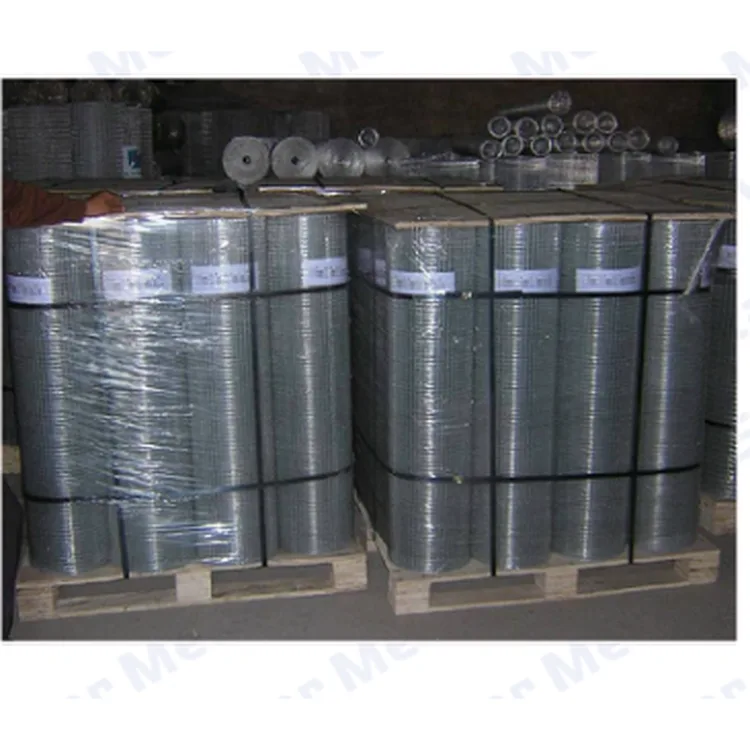
Standard roll widths run 12" to 60" (0.3–1.5m), with 36" (0.9m) and 48" (1.2m) the North American volume sizes, in standard roll lengths of 25m or 30m (82 or 98 ft). Rolls are wrapped in waterproof paper with a plastic cloth outer for sea freight, palletized or loose-loaded to suit the buyer. Cut-to-size panels for fabricators are available against drawings.
| Spec | Standard range | Imperial |
|---|---|---|
| Mesh counts | 2×2 to 60×60 per inch | Same (count is already per inch) |
| Wire diameter | 0.16–1.65mm by count | ~34–16 BWG span |
| Roll width | 0.3–1.5m | 12–60 in |
| Roll length | 25m / 30m | 82 / 98 ft |
| Finishes | HDG or EG (before or after weaving), enamelled, PVC-coated, stainless | — |
| Packing | Waterproof paper + plastic cloth outer | Sea-worthy |
Finishes and when to specify each
Square woven mesh leaves the loom in one of five finishes:
- Electro-galvanized (EG) — bright, smooth, economical; right for indoor screens, enclosures and short-service uses.
- Hot-dip galvanized (HDG) — the outdoor standard, with the option of galvanizing before or after weaving. Weaving pre-galvanized wire is cheaper; galvanizing the woven cloth afterward seals every crossing point and is the better spec for permanent outdoor exposure. The full trade-off is covered in our electro vs hot-dip and before-vs-after guides, and the base product is the same galvanized wire we sell in coils.
- Enamelled — a baked dark coating used for stove screens, fireplace guards and decorative panels.
- PVC-coated — colored polymer over galvanized core for coastal and garden exposure, matching our PVC-coated wire construction.
- Stainless steel — for chemical, food-adjacent, marine and architectural work where no coating is acceptable.
Fine counts (30×30 and up) are usually woven from galvanized or stainless wire directly, since post-coating can clog sub-millimeter openings.
What square woven mesh is used for
The three classic applications our export buyers order against:
- Screening loam, sand and aggregates. 2×2 to 8×8 mesh in the heavier wire options makes hand and frame screens for topsoil, compost, sand and gravel grading. Woven crimped construction absorbs impact better than light welded sheet at these sizes.
- Window and skylight protection. 8×8 to 16×16 in mid-to-heavy wire stops debris, birds and intruders while keeping light and airflow; the same specs serve machine guards and vent covers.
- Bird feeders and small-animal products. 4×4 and 8×8 in 0.4–0.9mm wire form feeder tubes, suet cages and hutch floors — stiff enough to hold shape, open enough to feed through.
Beyond these, 16×16 to 30×30 covers insect screening, and 30×30 to 60×60 feeds sieve, filter and dust-screen fabricators. For structural panels with larger apertures — partitions, fence infill, concrete work — a welded product is usually the better tool; compare our welded wire mesh. For flexible, curved or poultry applications, twisted hexagonal netting takes over.
How to write a complete mesh RFQ
Quote-ready specifications name six items: mesh count (per inch, both directions if not square), wire diameter in mm, finish (EG / HDG before or after weaving / enamelled / PVC core-overall / stainless grade), roll width, roll length (25m or 30m), and quantity in rolls or square meters. If your application is sieving to a particle size, specify the opening in mm or microns instead and let us set the count/diameter pairing — that avoids the classic error of ordering a count whose standard wire gives the wrong cut point. Samples of competing specs (e.g. 16×16 × 0.30mm vs 16×16 × 0.40mm) ship free against a serious inquiry, and each production run carries a certificate with measured count, wire diameter and coating.
Frequently asked questions
What does mesh count mean in woven wire mesh?
Mesh count is the number of wires per linear inch (25.4mm), counted from the center of one wire to the center of the wire one inch away. A 4×4 mesh has four wires per inch each way. Count sets the wire spacing, but the clear opening also depends on wire diameter: opening = (25.4 ÷ count) − wire diameter.
What size opening does 4-mesh or 16-mesh have?
With standard mid-range wire, 4×4 mesh (0.56–0.89mm wire) gives openings around 5.5–5.8mm (about 0.22"), and 16×16 mesh gives roughly 0.95–1.4mm openings depending on where in its 0.21–0.63mm wire range you specify. Always confirm both count and wire diameter — the same count can be woven into a light screen or a security screen.
Is woven mesh better than welded mesh?
They serve different jobs. Woven mesh covers fine counts (welding is impractical below a few millimeters of aperture), flexes without breaking joints, and suits screening and sieving. Welded mesh is stiffer, holds a flat plane, and is better for structural panels, guards with large apertures and fencing. From 2×2 to about 1/2" apertures the two overlap, and price and stiffness decide.
Which finish should I choose for outdoor mesh?
Hot-dip galvanized after weaving is the strongest bare-metal choice because the zinc bath seals every wire crossing; galvanized before weaving is the economical standard for general use. PVC-coated mesh adds a color barrier for coastal and garden exposure, and stainless steel removes coating life from the equation entirely for chemical and marine service.
What roll sizes does square woven mesh come in?
Standard export rolls are 12" to 60" (0.3–1.5m) wide and 25m or 30m (82 or 98 ft) long, packed in waterproof paper with a plastic cloth outer wrap. Custom widths within that span, cut panels and mixed-SKU container programs are routine for wholesale orders.
